In 2006 I made a two-channel video. The first channel is a pair of hands resting in a lap, unbound. In the second, the same hands are tied. Neither one holds its state. Neither one ends. I called it The Constant Battle Against Self-Constraints (an endless loop).

The Constant Battle Against Self-Constraints (an endless loop), 2006. Two-channel video, shown here at native resolution.
There’s a third state it doesn’t show.
Not tied. Not untied. Something harder to photograph.
A poet thirty years into iambic pentameter stops hearing it. The form is the shape thought takes when they’re trying to say something precisely. Thirty years of absorption have moved it from exterior to interior. The constraint and the person are no longer separate enough to tell apart.
That’s different from freedom. The constraint is still there, still defining the possible moves, still generating the pressure that makes the work specific. It stops feeling like constraint and starts feeling like thinking.
There’s a shadow version. A constraint internalized just as completely and no longer the useful kind.
A songwriter has a hit at twenty-six. It pays for the next thirty years. The show still closes with it, same key, same arrangement, because that’s what the room bought tickets for. He has played it something like four thousand times and he plays it better than he did at twenty-six. He has found things in it that he didn’t put there. The nights he plays something new, the room waits politely for the new thing to be over.
Whether he would still play it if nobody paid him is not a question he can run. The contract and the audience and the royalty statement arrived from outside. They stopped being outside somewhere in the second decade.
The person who can only write sonnets. The therapist who sees every patient through one theory. The constraint that started as a generator and became a rut.
From the inside, mastery and imprisonment can feel identical. Both have the ease of something automatic. Both have the confidence of deep familiarity. Both involve a narrowing of what you reach for.
The question of how to tell them apart is not one I can answer cleanly.
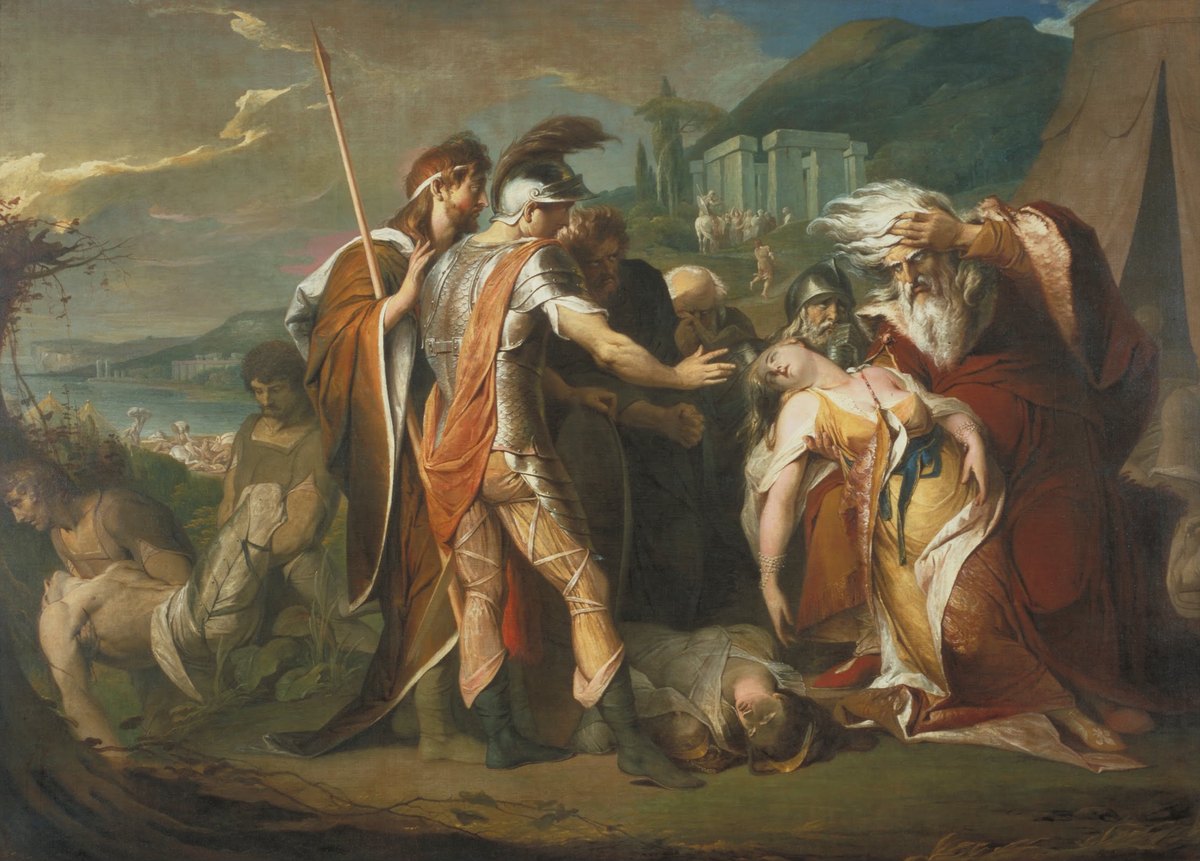
James Barry, King Lear Weeping over the Dead Body of Cordelia, 1786–88. Tate, London. Public domain.
At the end of King Lear, Lear comes onstage carrying his dead daughter. He says a few lines about the dog and the horse and the rat that get to keep their lives. Then:
Never, never, never, never, never.
A line of iambic pentameter runs five beats, each one an unstressed syllable followed by a stressed one. Here the stress lands first, every time. Five reversals in a row, the exact inverse of the meter the play is built on.
The line works because of the thousands of iambic lines in front of it. Invert the meter in a poem that hasn’t established one and nothing happens, because there’s no expectation to violate. Shakespeare spent five acts building the thing he breaks there.
You can only break the form productively from inside the form. A random inversion by someone who doesn’t know the meter is a mistake. The same inversion at the end of King Lear is a decision.
Mastery can break the form when breaking matters. Imprisonment can’t. The imprisoned constraint is no longer available to break, and breaking it feels like destruction instead of decision.
I’ve been running an LLM character for months, a boozy ex-politician I call Frank. Action vocabulary, novelty guards, phrase limits, all of it calibrated the way I described in the NPC article. His signature moves land in the eight to fifteen percent band, often enough to read as voice and seldom enough to wear out. He surprises me occasionally.
Turn 500 is the part I don’t have an answer for. The novelty guards start producing a pattern of their own, and a player a few hundred turns in learns its rhythm. The narrowing moves up a level, from “takes a long swig” to “varies his approach in these particular ways,” and it’s harder to see because I built the variation myself. The sessions are still running.
The obvious next question is whether Frank can break his own grammar that late and have it land as revelation instead of error. That question assumes something Frank doesn’t have.
Both of the tests I’ve been using require an inside. Lear works because Shakespeare built the expectation across five acts and then violated it. The songwriter is imprisoned because there’s a question about himself he cannot run. Both are about intention, and intention needs somewhere to live.
Frank has no inside for a constraint to move into. He accumulates nothing between turns. The action vocabulary is never absorbed, only re-supplied, and it sits as far outside him on turn 500 as it did on turn one. Thirty years would change nothing. There’s no interior for the rope to migrate into.
So he reaches neither state. What looks like Frank’s imprisonment is the highest-probability output reasserting itself the moment nothing is pushing against it.
Which puts turn 500 somewhere other than where I’d been putting it. Frank can’t decide to break his grammar. I can build a system that breaks it. The decision lives upstream of him, in the guards and the vocabulary and the judgment about when a rule should stop applying, and all of that is mine.
It’s a test of the builder, not the character. What it measures is whether I’ve made a character or a very sophisticated caricature.
The bound hands never get untied at the end. The free hands never find peace. Neither state wins, and I didn’t know how to make one win without lying.
What I’d add now, twenty years later, is a third channel. Hands that have been tied and untied and tied again. Hands that know the shape of the rope well enough to work without it.
I don’t know how I’d shoot it. On a monitor it would look like a pair of hands resting in a lap, which is what the first channel already looked like.
The Constant Battle Against Self-Constraints (an endless loop) is available on YouTube.
Related reading
- The Constant Battle Against Self-Constraints: the visible constraint and the invisible one
- Where the Feet Need to Be: what moves when a constraint stops feeling like one
The NPC work that Frank comes from is written up in Why Your LLM NPCs Sound the Same.
The TBC posts, on NTSC signal instability as a metaphor for trauma recovery, are Part 1 and Part 2.